
Breaking. Massive Russian Air Attack
3 min read
This morning from 3am, Russia launched a massive air attack on Ukraine. This is believed to be retaliation for the sinking of a Russian warship on the 26 Dec in the occupied Crimean port of Feodosia.
Russia has acknowledged the damage sustained by a warship in the occupied Crimean port of Feodosia as a result of a Ukrainian attack a significant setback for the Russian navy, as reported by Ukraine and its Western allies. The targeted vessel, the Novocherkassk landing ship, known for its capacity to transport soldiers, tanks, and armoured vehicles, was declared “destroyed” by Ukraine’s air force. President Volodymyr Zelenskyy added a touch of humour on social media, stating that the ship had now joined “the Russian underwater Black Sea fleet.”
In response Russia launched a significant air assault this morning. Cities and critical infrastructure throughout the country were targeted by Russian drones and missiles, resulting in the tragic loss of nine lives and leaving dozens injured. The situation underscores the urgent need for assistance to address the mounting humanitarian and security challenges faced by Ukraine in the wake of these devastating attacks.
According to President Zelensky on Telegram, Russia launched approximately 110 missiles, with the majority being successfully intercepted. Despite the effective defense, President Volodymyr Zelenskyy has confirmed that some strikes did penetrate the defenses, resulting in casualties and damage. The situation underscores the ongoing challenges faced by Ukraine in countering the military aggression and highlights the human and infrastructural toll inflicted by the attacks.
“Today, Russia launched almost everything it has in its arsenal: Kinzhal hypersonic missiles, S-300 anti-aircraft missiles, cruise missiles and UAVs. Strategic bombers launched Kh-101/Kh-505 missiles. Approximately 110 missiles were launched, and most of them were shot down. Unfortunately, people were killed and wounded as a result of the attack.”


In related news the European Union is devising a contingency plan, valued at up to €20 billion, to support Ukraine. This alternative plan aims to address concerns raised by Hungary’s Viktor Orbán, enabling financial assistance for the war-torn country. EU leaders encountered difficulties in reaching a consensus on the initially proposed €50 billion four-year package for Ukraine earlier this month. In light of these challenges, officials are exploring alternative solutions to avert a potential budget crisis for Kyiv, emphasizing the importance of finding common ground among EU member states.
Unfortunately a decision on this Plan B will not be made until after the Feb 1st planned summit where members will see if Orban uses his veto on the initial €50 billion they are still trying to push through. Either way funds would not be made available until March. This may be too little too late if the Russian attacks continue at this intensity.
Meanwhile in America the last $250 million package this year before Congress reconvenes in the New Year was approved, albeit with a tepid response from Kyiv. Comprising artillery shells, air defence equipment, anti-aircraft and anti-tank missiles, and small arms ammunition for countering Russia, aims to address certain battlefield shortfalls. However, despite this support, Ukraine still confronts an uncertain future and lacks critical financial assistance as it enters the new year. The aid package, while bolstering military capabilities, underscores the broader challenges and needs faced by Ukraine in navigating the ongoing conflict and its aftermath.
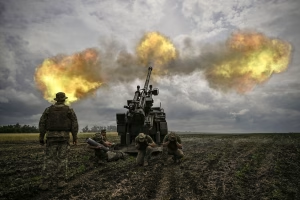
How will Zelensky respond or more importantly how can he respond? In March the European Union committed to providing one million shells to Ukraine within a year, which amounts to a third of the requested quantity. By the end of November, 300,000 shells had been delivered from the stockpiles of European armies. However, to fulfil the remainder of the pledge, new production will be necessary, according to Josep Borrell, the EU’s foreign policy chief. With four months left to bridge the gap, the focus is on ramping up production to meet Ukraine’s needs in a timely manner.
Unfortunately it looks like the odds in this war of attrition favours Russia, having considerably more ammunition especially shells available. North Korea has already provided 10% of the 10 million shells ordered by Russia which gives it a massive superiority over Ukraine who is now rationing use to 110,000 shells per month.
Lets see what Zelenskys next move will be.


Leave a Reply