Russia Is Gaining in Ukraine — Here’s Why the Momentum Has Shifted
3 min read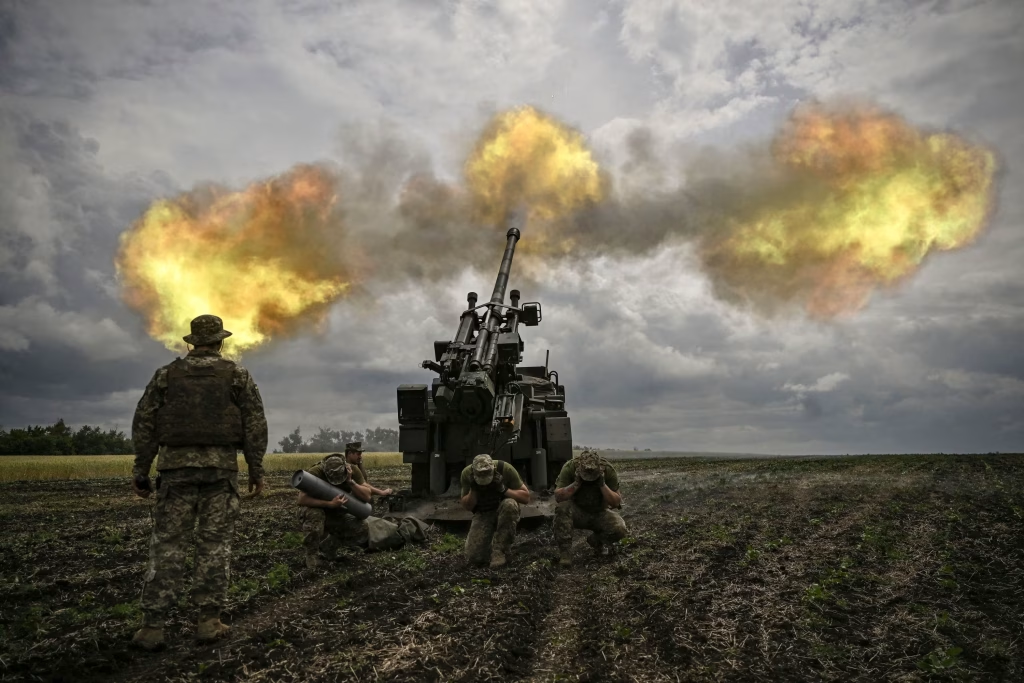
For much of the past two years, coverage of the war in Ukraine has oscillated between optimism and alarm, often driven more by political messaging than battlefield reality.
But beneath the headlines, a quieter shift has been taking place.
Measured not in dramatic breakthroughs but in attrition, logistics, and sustainability, Russia is steadily gaining the upper hand against Ukraine.
This is not a story of sudden collapse or decisive victory. It is a story of structural advantage.
This Is an Attritional War — and Attrition Favors Scale
Modern warfare at this intensity is no longer about manoeuvre alone. It is about:
- Ammunition volumes
- Industrial throughput
- Replacement of equipment
- Manpower rotation
- Political tolerance for loss
On these variables, Russia holds enduring advantages.
Artillery — still the dominant killer in the conflict — remains central. Russia continues to fire significantly more shells per day than Ukrainian forces, not because of tactical brilliance, but because it can produce, stockpile, and supply them at scale.
Attrition wars reward the side that can lose more without breaking. That reality is uncomfortable, but unavoidable.
Western Supply Is Constrained by Politics and Industry
Ukraine’s battlefield performance has been closely tied to Western military aid. That aid, however, is neither infinite nor frictionless.
Key constraints are now visible:
- Industrial limits: Western defence production was not configured for sustained high-intensity war. Expanding capacity takes years, not months.
- Political fatigue: Aid packages require parliamentary approval, budget negotiations, and electoral support — all increasingly contested.
- Logistical complexity: Advanced Western systems require training, maintenance, and spare parts, creating long tails of dependency.
Russia, by contrast, operates on shorter supply chains, simpler systems, and domestic political control that allows losses to be absorbed without immediate strategic reversal.
Ukraine’s Manpower Problem Is Becoming Central
Territory can be regained. Equipment can be replaced. Trained manpower is harder to regenerate.
Ukraine faces a worsening demographic and mobilisation challenge:
- A smaller population base
- High casualty rates among experienced units
- Political resistance to broader conscription
- Strain on civilian morale and economic capacity
Russia’s mobilisation model is imperfect, but numerically deeper. It can rotate forces, absorb losses, and maintain pressure in ways Ukraine increasingly struggles to match.
This imbalance does not produce headlines — it produces slow, grinding momentum.
Time Is No Longer Neutral
For much of the conflict, Ukraine benefited from the assumption that “time is on our side” — that sanctions would bite, that Western resolve would harden, and that Russian capacity would erode faster.
That assumption is now under strain.
Russia has:
- Adapted its economy to sanctions
- Redirected trade flows
- Increased defence output
- Learned operational lessons at high cost
Meanwhile, Ukraine’s strategic position depends on continued external support, which is subject to political cycles it does not control.
In long wars, dependency is a vulnerability.
Why This Doesn’t Look Like Victory — Yet
Russia’s advantage does not mean imminent collapse of Ukrainian lines or dramatic territorial conquest.
Instead, it manifests as:
- Incremental advances
- Sustained pressure across multiple fronts
- Forcing Ukraine to defend everywhere at once
- Wearing down reserves faster than they can be replenished
This is how wars are won when outright breakthroughs are unlikely.
Not with spectacle — but with exhaustion.
The Strategic Implication Western Leaders Avoid
Acknowledging this shift is politically difficult.
It raises uncomfortable questions:
- What does “success” now mean?
- Is the objective recovery of all territory, or prevention of defeat?
- How long can current levels of support be sustained?
- What is the end state being pursued?
Avoiding these questions does not make them disappear. It simply delays the reckoning.
Conclusion: Momentum Matters More Than Headlines
Wars are not decided by press conferences or pledge announcements. They are decided by industrial capacity, manpower, and time.
On those metrics, Russia is slowly but clearly gaining the upper hand.
That reality does not dictate a single outcome — but it does narrow the range of plausible ones.
Ignoring momentum does not stop it.
It only ensures surprise when consequences arrive.
Flat Out News publishes independent analysis on geopolitics, energy, markets, and the narratives shaping the modern world.