Russia Is Gaining the Upper Hand in Ukraine
4 min read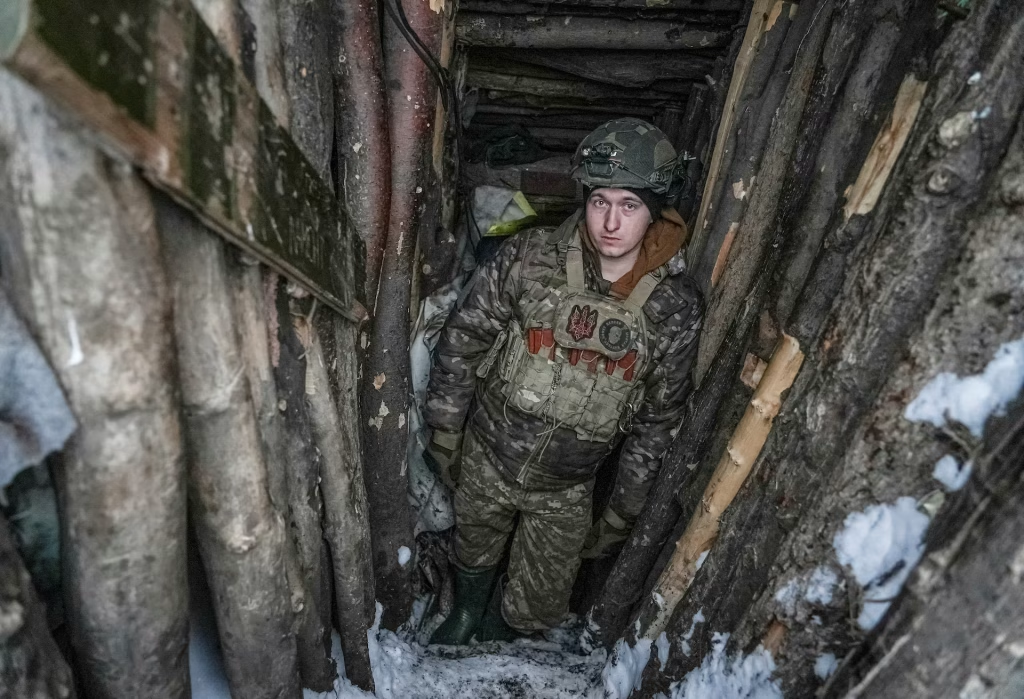
People in the West have become numb to big, outrageous statements. We’ve been trained to treat rhetoric as noise. But the Russia–Ukraine war isn’t being decided by rhetoric. It’s being decided by industrial capacity, manpower, and time — and on those inputs, Russia is increasingly shaping the battlefield.
This isn’t a claim that Ukraine “collapses tomorrow.” It’s a claim that the direction of travel is changing, and it’s changing for reasons that don’t show up in press conferences.
1) The War Isn’t Primarily About Maps — It’s About Degrading Capability
Western commentary still frames this as a territorial contest: who holds what village, who advances what kilometre.
Russia’s operational approach has looked different for a long time. The pattern is consistent: grind, fix, attrit, and keep pressure on Ukraine’s ability to field and sustain effective formations. The territory comes as a consequence of that — not always as the main event.
That’s why withdrawals and “non-decisive” moves have happened when holding ground didn’t serve the longer objective. It’s also why Russia has often preferred slow momentum over dramatic gambles.
2) Attrition Rewards Scale — and Russia Has More Scale
Attritional war is ugly math. It rewards the side that can:
- manufacture more ammunition over time
- replace more equipment over time
- rotate manpower over time
- absorb losses without political fracture
That doesn’t mean Russia is “invincible.” It means the model of warfare being fought — artillery, drones, mines, fortifications, and constant reconnaissance — naturally favours the side with deeper reserves and a war economy that can be sustained.
Ukraine can fight brilliantly and still be forced into a position where every month costs more than the month before.
3) Western Support Is Powerful — But It’s Not Unlimited or Frictionless
Ukraine’s capacity to sustain high-intensity combat is intertwined with Western supply. The problem is that Western supply has three hard constraints:
- Politics — packages get delayed, negotiated, re-traded, and used as domestic leverage.
- Industry — defence production cannot be scaled instantly; it’s a multi-year retooling problem.
- Logistics — advanced systems require training, spares, maintenance, and integration, which creates a long tail of dependency.
Ukraine is fighting a war. Its supporters are managing budgets, elections, parliaments, and coalition politics. Those are not the same environment, and over time the mismatch shows.
4) Manpower Is Becoming the Centre of Gravity
Equipment can be shipped. Money can be printed. Trained manpower is different.
Ukraine’s manpower challenge is structural: smaller base, exhaustion, rotation strain, and the compounding loss of experienced soldiers. Even if you disagree with any specific casualty figures floating around online, the strategic truth holds: sustained high-intensity war burns through trained people faster than training pipelines can replace them.
When that happens, the quality of units declines, the defence becomes thinner, and tactical setbacks become harder to reverse.
5) “Time” Is No Longer Neutral
For a long period, the West operated on an implicit assumption: time would degrade Russia faster than Ukraine.
But Russia has adapted. Sanctions pressure hasn’t produced the strategic collapse many predicted. Production lines have been shifted. Trade flows have been rerouted. The Russian state has pushed cohesion and continuity in a way Western democracies struggle to replicate during prolonged conflict.
Meanwhile, Ukraine’s dependence on external support means time is not simply an ally. Over time, dependency becomes a vulnerability.
6) The Frontline Reality: Drones, Trenches, and Visibility Everywhere
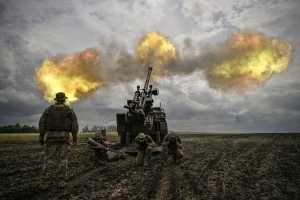
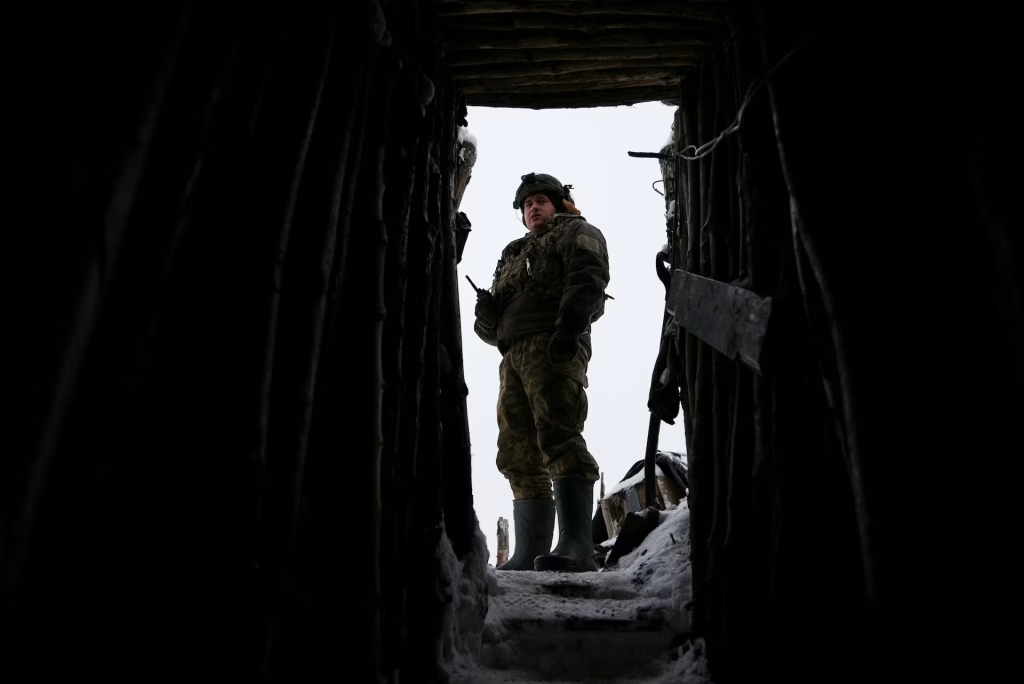
This war has evolved into something closer to a modernised First World War than most people expected — with one major difference: persistent drone surveillance and targeting reduces concealment and makes manoeuvre brutally expensive.
That reality rewards defensive depth, mines, fortification, and constant fire support.
Ukraine fortifications / trenches
7) Why You Don’t See “Victory” — Yet
Russia gaining an upper hand doesn’t necessarily mean sweeping breakthroughs. In this type of war, advantage often appears as:
- incremental advances
- forcing Ukraine to defend multiple axes
- stretching reserves
- degrading logistics and repair cycles
- exhausting political bandwidth in Europe and North America
It’s less cinematic. More decisive.
What This Means
The uncomfortable point is this: narratives don’t stop momentum.
You can keep repeating “Ukraine is about to win” or “Russia is about to collapse,” but the war keeps running on logistics, manpower, and industrial output. At some point, the narrative hits the wall of reality.
Map showing how war maps frame (and hide) information (University of Richmond feature).

Conclusion
The war is drifting toward an end state shaped by attrition and exhaustion, not by slogans. Russia is gaining the upper hand because it is operating with structural advantages in the kind of war that is actually being fought.
That doesn’t dictate the exact political settlement. It does narrow the range of plausible outcomes.
And it should force one honest question in every Western capital:
What is the strategy for an end state — not just for “the next package”?
This piece is not written to provoke, defend, or condemn any side. It is written to address a growing gap between public narratives and battlefield realities. Wars are not decided by rhetoric or wishful thinking, but by manpower, logistics, industry, and time. Ignoring those fundamentals does not change outcomes — it only delays recognition of them.